
Cucumber Production
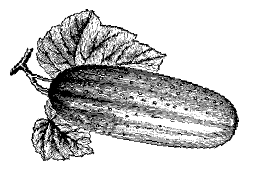 Cucumbers
are a crop that lend themselves well to smallscale
and part-time farming operations. Multiple markets
exist for growers with five acres or less, and many field
Cucumbers
are a crop that lend themselves well to smallscale
and part-time farming operations. Multiple markets
exist for growers with five acres or less, and many field
operations, such as land preparation, planting, and harvesting, can be
custom hired.
Cucumbers (Cucumis sativas) are a member of the cucurbitaceae family, which also includes squashes, pumpkins, muskmelons, watermelons, and gourds. Normally, cucumber plants are monoecious—they produce both male and female flowers on the same plant. Male flowers appear on the main stem earlier and in much larger numbers than female flowers. New, modern hybrids are gynoecious—plants produce only female flowers and are referred to as all-female varieties.
Cucumbers are native to India and were introduced into
China 2,000 years ago. They were then brought to Europe,
most likely first into Greece, from which their cultivation
spread into Italy, Germany, and France. Pliny the Great
stated that cucumbers were grown in Africa as well as Italy
in his time, and that the Emperor Tiberius (14-37 A.D.) had
cucumbers at his table every day. Cucumbers were grown
by Columbus in Haiti in 1494. In 1539, De Soto found
varieties of cucumbers in Florida that were better than those
grown in Spain, and cucumbers were also reported to be
grown in Virginia in 1609. Early cucumber varieties were
not as smooth or symmetrical as current varieties, and
breeding work to produce hybrids did not begin until 1880.
The United States harvested cucumbers for two basic purposes: processing and fresh marketing. In 1998, the U.S. produced 102,000 acres of processed cucumbers with a value of $140 million and produced 58,000 acres of freshmarket cucumbers, valued at $244 million. (USDA Statistical Services bases value of production on total acres harvested times average price.) Pennsylvania produced 800 acres of fresh-market cucumbers with a value of $6 million.
Marketing
Fresh market cucumbers are usually available in Pennsylvania
from the end of June to the end of November. They
traditionally are sold in 47 to 55 pound wooden crates or
cardboard boxes. Five basic marketing alternatives are
available to the cucumber grower: wholesale marketing,
cooperatives, local retailers, roadside stands, and pick-yourown
operations.
In
wholesale marketing, producers often contract with
shippers to market and ship the cucumbers for a predetermined price. If you
do not use a contractor and ship your cucumbers to a wholesale market
yourself, your product will be subject to the greatest price fluctuations.
Marketing cooperatives generally use a daily
pooled cost and price, which spreads price
fluctuations over all participating
producers. Local retailers are another possible market, but
you must take the time to contact produce managers and
provide good-quality cucumbers when stores require them.
Roadside stands (either your own or another grower’s) and
pick-your-own operations provide opportunities to receive
higher than wholesale prices for your cucumbers, but you
may have some additional expenses for advertising, building
and maintaining a facility, and providing service to your
customers. With pick-your-own operations, you save on
harvest costs, but you must be willing to accept some waste.
Depending on your location, processors may or may not be a marketing option. Processors are less likely to contract with small-acreage growers (those with less than 5 acres).
For more information on marketing, consult Agricultural
Alternatives: Fruit and Vegetable Marketing for Small-Scale
and Part-Time Growers.
This publication was developed by the Small-Scale and
Part-Time Farming Project at Penn State with support from
the U.S. Department of Agriculture-Extension Service.


|
|
 |
|
